
Note: Please also read the "Reflection" and "Working with a Supervisor" sections in this guide.
Supporting the extended essay: The role of the supervisor
Supervisors are required to:
In addition, it is strongly recommended that supervisors:
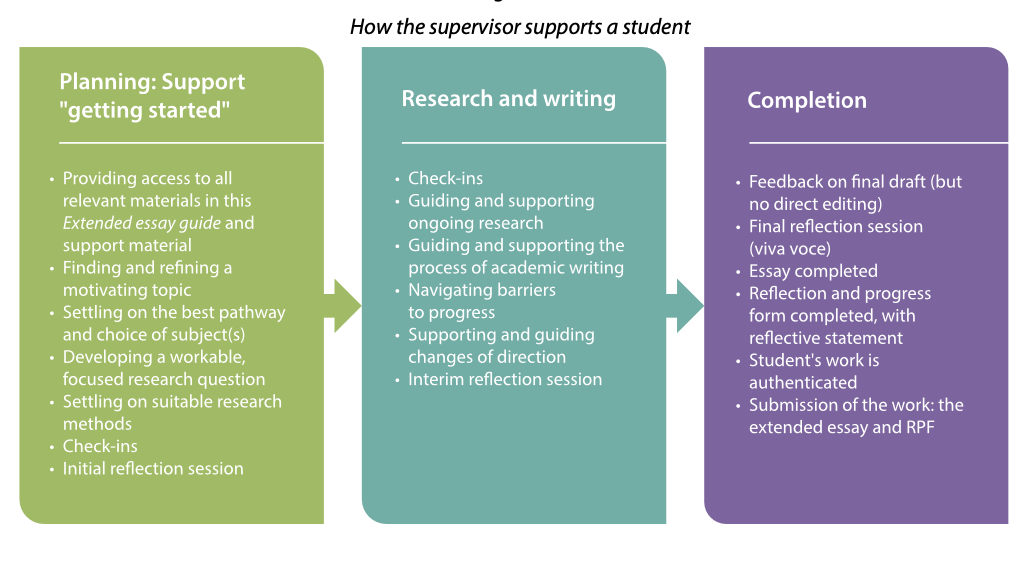
Attendance at the three mandatory reflection sessions must be recorded on the RPF. It is recommended that these last 20 to 30 minutes. Students need to be well prepared for the sessions, where the supervisor will prompt them with questions. Supervisors will focus on progress made and help set clear objectives for moving forward. Students may therefore find it useful to share excerpts from their RRS in the session.
What happens at the three reflection sessions?
In each of the reflection sessions, students discuss their extended essay experience with the supervisor. To make this a useful aspect of reflective thinking, students should keep a record of the discussions.
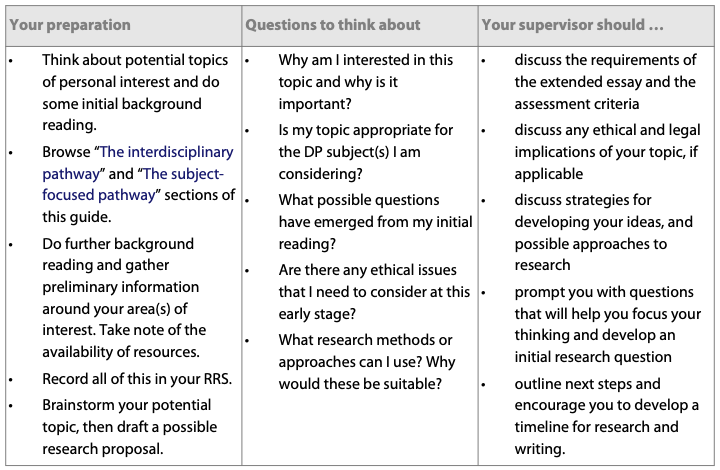
Other Areas to Focus On...
The student's initial ideas regarding their chosen topic
The research question they have in mind
Any initial background reading or research they may have conducted
The possible approaches they are considering
Their initial thoughts about the answer to their research question
Guiding Questions to Ask:
What exactly are you trying to find out?
What resources do you plan to use?
What problems do you anticipate encountering?
To what extent does your topic fit within the subject's EE criteria?
What sources have you found, and what do you still need to find?
Have you collected sufficient data? (if applicable)
Why are you interested in researching this?
Do you have sufficient knowledge in the subject area to fulfill the EE requirements?
Are there any ethical issues to consider before beginning this research?

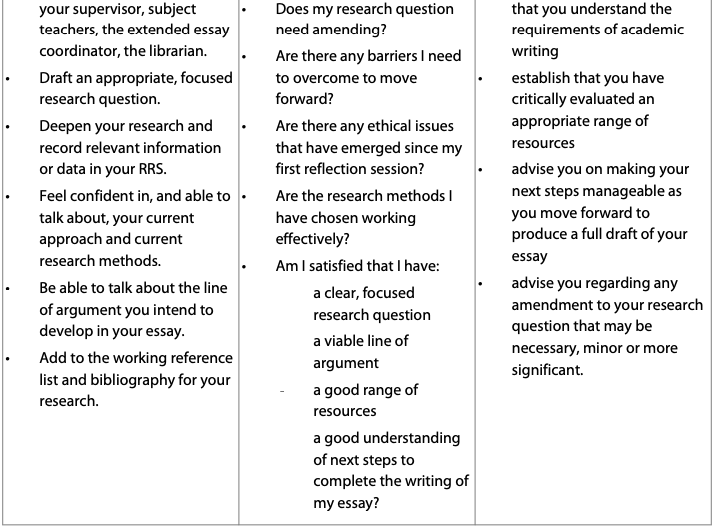
The Second Reflection session usually occurs in the middle to latter half of the student's EE process.
In this session, you should guide the student to:
Guiding Questions to Ask:
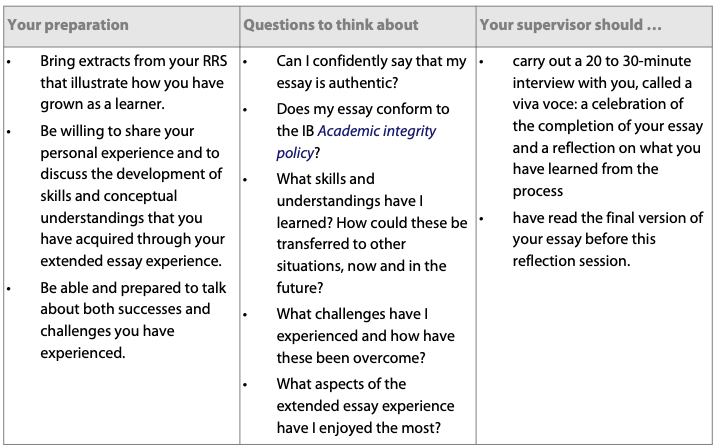
The Third Reflection can be written by the student before the Viva Voce meeting to help them prepare for the conversation.
Your role is to prompt them to:
Guiding Questions to Ask:
Commenting on one completed draft of the essay is a very important aspect of the latter stages in the process, and the last point at which the supervisor sees the essay before it is finally uploaded for submission. It is therefore vital that the level of support given is appropriate—too little support and the ability of the student to meet their potential is compromised; too much help and it will not be the work of an independent learner.
The best way of conducting this last stage is for the student to submit the essay prior to a supervision session to allow the supervisor to add their comments. This should be followed by a one-to-one discussion between the supervisor and the student in which they go through the comments together as these become a starting point for a dialogue about the essay. This advice should be in terms of the way the work could be improved, but the draft must not be heavily annotated or edited by the supervisor.
 What supervisors can do
Comments can be added that indicate that the essay could be improved. These comments should be open-ended and not involve editing the text, for example:
 What supervisors cannot do:
If students give their supervisor sections of their extended essay to read, this is permissible but the same section of work should not be looked at repeatedly by the supervisor, nor should it be heavily annotated or edited. Students and supervisors must be clear that only one complete draft of the essay is permitted to be looked at by the supervisor.
Completing the RPF is a requirement for the submission of the extended essay. The RPF plays an important role in the assessment of the final essay and represents the learning and personal growth of the student. The following is offered as guidance for the completion and submission of the form.
The RPF can be found on the extended essay website (Home > In practice > Reflection and progress form). The form includes drop-down options for the month and DP year to indicate when the reflection sessions have taken place during the student’s DP or extended essay studies. If a student is a retake student, use “DP year 2” to indicate reflections that have taken place in the academic year that the student will submit their essay.
At least four elements of the extended essay process help the supervisor to ensure that the essay is all the student’s own work.
The goal is to help students develop the values and skills associated with academic writing and integrity and to prevent or pre-empt academic misconduct.
Supervisors will find it useful to refer to the “Academic integrity” section of the Extended essay support material for specific guidance.
All extended essays submitted to the IB for assessment must be authenticated by the student and supervisor and must not include any known instances of suspected or confirmed academic misconduct. All students and supervisors must confirm the authenticity of the work that is to be uploaded to the eCoursework system. Once the authenticity of the student’s work has been determined, it is ready to be uploaded to the eCoursework system for assessment. At this point, the supervisor must not allow any retraction of the essay by the student for modification purposes unless there has been an administrative oversight.
The completed RPF is initialled and dated by the supervisor. Then it can be uploaded to the IB eCoursework system with the essay. The upload process represents authentication of the student’s work.
It is extremely important that supervisors can confirm that they have followed the guidance for monitoring the student’s work throughout the process and can, to the best of their knowledge, confirm the authenticity of the work at submission (please refer to the Diploma Programme Assessment procedures).
If the supervisor is unable to confirm the authenticity of the work, this must be brought to the attention of the DP coordinator, who in turn should refer to the Diploma Programme Assessment procedures for guidance. No piece of student work should be uploaded or submitted to the eCoursework system if its authenticity is in doubt. It should be fully understood and noted that work that is submitted but does not comply with the expectations and requirements outlined in this guide will be treated as a case of academic misconduct.
At any stage during the extended essay process, if authenticity is in doubt, the supervisor’s first step should be to discuss this with the student. In addition, one or more of the following actions may be helpful.
It is the responsibility of supervisors to ensure that students understand the meaning of academic integrity, especially the concepts of authenticity and intellectual property. Supervisors must ensure that students understand that the extended essay must be entirely their own work. It should also be made clear that the same piece of work cannot be submitted to meet the requirements of both the extended essay and another DP assessment component.
For further guidance on this issue and the procedures for confirming authenticity, refer to the Diploma Programme Assessment procedures.
Supervisors are reminded that students must acknowledge all sources used in work submitted for assessment. The following is intended as a clarification of this requirement. DP students submit work for assessment in a variety of media that may include audiovisual material, text, graphs, images and data published in print or electronic sources. If students use the work or ideas of another person, they must acknowledge the source using a standard style of referencing in a consistent manner.
The IB does not prescribe which style(s) of referencing or in-text citation should be used by students; this is left to the discretion of the student’s school. The wide range of subjects used in the extended essay, the different response languages and the diversity of referencing styles make it impractical to insist on a particular style. Therefore, schools are free to choose a style that is appropriate for the subject concerned and the language in which students’ work is written. However, the following criteria should be applied.
Note: Examiners are required to alert the IB when minimum referencing and citing requirements are not met by a student, and the work will then be investigated accordingly.
Students must ensure that they are not using material submitted for any other DP assessment element as part of their extended essay submission. While resources can be shared between elements, it is advisable to avoid this. Resources used for an internal assessment (IA) task, for example, may be relevant to an extended essay topic. However, it is important to note that none of the student's content from one of their submissions can be duplicated in another submission. To prevent any “double-dipping”, the student will need to have a substantially different angle and focus for the extended essay investigation. Supervisors play an important role in guiding students on these distinctions, bearing in mind that students risk not being awarded their diploma if academic misconduct is detected.
After commenting on one full draft, the next version of the essay that the supervisor sees must be the final one submitted to them before the viva voce. This version of the extended essay must be “clean”: it must not contain any comments from the supervisor or any other person. Once this version has been submitted to the supervisor and discussed, students are not permitted to make any further changes to it, unless deemed appropriate by the supervisor because of an administrative error. For this reason, students must ensure that their work meets all formatting and submission requirements before it is uploaded.
Under the Assessment tab in Managebac choose the appropriate number for each criterion. The total points will be shown in the box at the bottom of the page. Alternatively, you can skip individual criterion and assign a letter grade (descriptors below). DO NOT FILL OUT THE COMMENT BOX ON THE ASSESSMENT TAB.
This mark will be used as your predicted grade that will be submitted to the IB.
For more details about assessment, look at the 'Assessment of the EE' section in the guide.
Five Criterion:
Total: 30 points
Assessment grade descriptors for the extended essay
Grade A
• The student demonstrates effective research skills, resulting in a well-focused and appropriate research question that can be explored within the scope of the chosen topic.
• There is effective engagement with relevant research areas, methods and sources.
• There is excellent knowledge and understanding of the topic in the wider context of the relevant discipline.
• There is effective application of source material and correct use of subject-specific terminology and/or concepts that further supports this.
• Conclusions are consistent, relevant and proficiently analysed.
• Arguments show sustained reason and are supported effectively by evidence.
• Research is critically evaluated.
• Coherence, consistency and effective use of structural conventions support readability to an excellent degree.
• Reflection on the extended essay learning experience is consistently evaluative and includes specific examples.
• Reflection shows consistent evidence of the student’s growth and transfer of learning.
Grade B
• The student demonstrates appropriate research skills, resulting in a research question that can be explored within the scope of the chosen topic.
• There is reasonably effective engagement with relevant research areas, methods and sources.
• There is good knowledge and understanding of the topic in the wider context of the relevant discipline.
• There is a reasonably effective application of source material and reasonable use of subject-specific terminology and/or concepts.
• Conclusions are consistent and accurately analysed.
• Arguments show reason and are often supported by evidence.
• Research at times shows critical evaluation.
• Coherence, consistency and use of structural conventions support readability to a good degree.
• Reflection on the extended essay learning experience is partially evaluative and includes specific examples.
• Reflection often shows evidence of the student’s growth and transfer of learning.
Grade C
• The student demonstrates evidence of research undertaken, leading to a research question that is not necessarily expressed in a way that can be explored within the scope of the chosen topic.
• There is partially effective engagement with mostly appropriate research areas, methods and sources. However, there are some discrepancies in those processes, although these do not interfere with the planning and approach.
• There is some knowledge and understanding of the topic in the wider context of the discipline, and the knowledge is mostly relevant.
• There is an attempted application of source material and appropriate terminology and/or concepts; an attempted synthesis of research results with partially relevant analysis.
• Conclusions are partly supported by the evidence.
• Arguments are descriptive rather than analytical.
• There is a partially successful evaluation of the research.
• The essay is not always coherent and consistent, and structural conventions are irregularly applied, but this does not significantly hinder readability.
• Reflection on the extended essay learning experience is descriptive and includes some specific examples.
• Reflection sometimes shows evidence of the student’s growth and transfer of learning.
Grade D
• The student demonstrates a lack of research, resulting in unsatisfactory focus and a research question that is not answerable within the scope of the chosen topic.
• At times, there is engagement with appropriate research, methods and sources, but discrepancies in those processes occasionally interfere with the planning and approach.
• There is some relevant knowledge and understanding of the topic in the wider context of the discipline but at times the knowledge is irrelevant.
• There is an attempted application of source material but with inaccuracies in the use of, or underuse of, terminology and/or concepts.
• There is irrelevant analysis and inconsistent conclusions as a result of a descriptive discussion.
• There is a lack of evaluation.
• The limited coherence and consistency of the essay and absence of structural conventions hinders readability.
• Reflection on the extended essay learning experience is descriptive.
• Reflection on the student’s growth is limited to a description of the process and there is no evidence of transfer of learning.
Grade E (a failing condition)
• The student demonstrates little or no research, a lack of focus and an ineffective research question.
• There is a generally unsystematic approach and a resulting unfocused research question.
• There is limited engagement with limited research and sources.
• There is generally limited and only partially accurate knowledge and understanding of the topic in the wider context of the discipline.
• There are ineffective connections in the application of source material, and inaccuracies in the terminology and/or concepts used.
• The results of research are summarized with inconsistent analysis.
• There is an attempted outline of an argument but one that is generally descriptive in nature.
• The lack of coherence and consistency and absence of structural conventions significantly hinders readability.
• Reflection on the extended essay learning experience is very limited, with no evidence of transfer of learning.
Source: EE Guide p.115-117
More specific information in the EE Guide for each specific subject: Choice of Topic & Treatment of Topic