
Curiosity is the engine of achievement.
-Ken Robinson
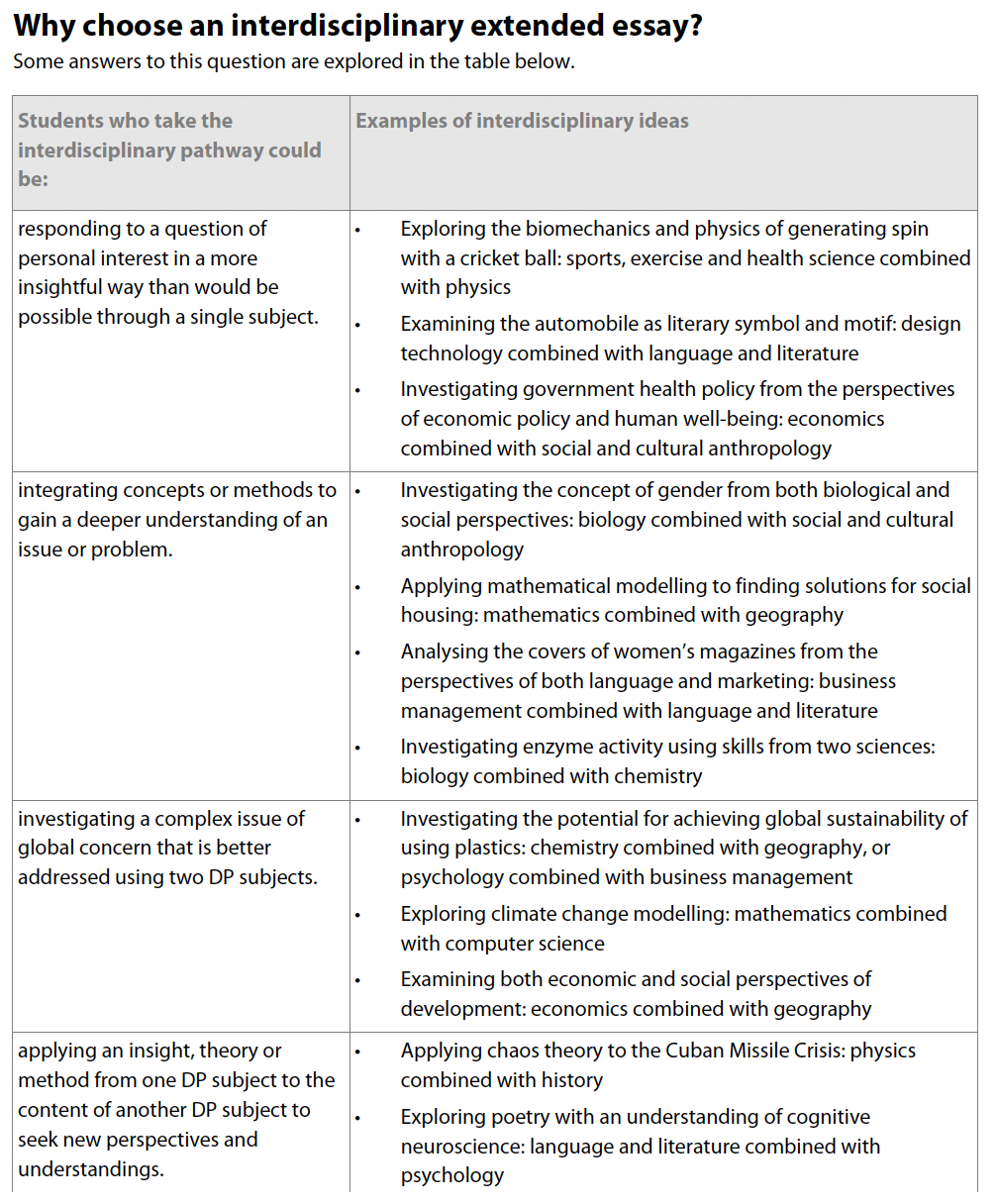
Your extended essay, whether interdisciplinary or subject-focused, should begin with an idea that is generated by your personal interest. Some ideas will suit exploration through the subject-focused pathway, while others will suit the interdisciplinary pathway if the ideas may be better explored through the combined lenses of two DP subjects. Imaginative interdisciplinary collaboration can open such topics to rich research.
You research and write your extended essay in an interdisciplinary way when you integrate knowledge, concepts, theories, perspectives or methods, or a combination of these, from two chosen DP subjects. In other words, elements of the two subjects are combined so that they work together effectively to help research an extended essay topic.
Ultimately, integration of two subjects can lead to fresh insights and create new and/or deeper understandings that would not be possible through research within one DP subject alone.
Note: As you will see in “The subject-focused pathway” section of this guide, there are two DP subjects that are categorized as “cross-disciplinary”: environmental systems and societies (ESS) and literature and performance.
It is not permitted to choose these subjects in the interdisciplinary pathway, only in the subject-focused pathway. This restriction aims to prevent over-complexity in your research and writing.
If you are interested in a topic that combines theatre and literature, choose literature and performance in the subject-focused pathway.
If you are interested in a topic that combines geography and biology, depending on the nature of your topic, consider choosing ESS in the subject-focused pathway.
A note on “integration”
“Integration” is a characteristic that develops and emerges as the research and writing of the extended essay progresses. It is not necessary to think of integration as a starting point. You can begin in a relatively straightforward way by focusing on incorporating some approaches from the two DP subjects you have chosen, and applying those approaches to the research question.
You can then develop a line of argument that is informed by connections made between elements of the two chosen DP subjects. Gradually, these elements can be synthesized, resulting in a conclusion that brings the reader a sense of how you have integrated the knowledge, concepts, theories, perspectives, methods, or a combination of these, from the two DP subjects. This will allow for the success of your integrative approach to be evaluated.
Guidance on interdisciplinary research and writing
If you decide that the interdisciplinary pathway is appropriate for your extended essay topic, further advice on how best to make this approach work is available in the Extended essay support material. Make sure that your supervisor shares the guidance you need or gives you access to it, from both the guide and the support material.
Balance between the two DP subjects
In an interdisciplinary extended essay, it is not necessary for you to achieve an evenly balanced combination of each of the two DP subjects. The relative balance will depend on the nature of the topic and the emphasis of the research question. However, an interdisciplinary extended essay should demonstrate clearly that integration of elements of the two subjects has specifically enabled an effective response to the research question.
Rigour in an interdisciplinary extended essay
To ensure rigour in an interdisciplinary extended essay, your understanding of the two DP subjects that are combined in an interdisciplinary essay needs to be evident. This understanding will contribute to the quality of the research, which is the overall measure of rigour in an extended essay. A more rigorous research process is likely to lead to more reliable findings. Consequently, it is strongly recommended that you are studying at least one of the two DP subjects you are using for the extended essay. You will then be bringing to the research process an emerging understanding of knowledge, concepts, theories, perspectives, methods, or a combination of these, from at least one DP subject. This understanding will be important in terms of developing an understanding of elements of the second DP subject and combining these in an effective interdisciplinary research pathway.
To safeguard the rigour of an interdisciplinary extended essay, it is important that you regularly check with your supervisor about the quality of your ongoing research and, if necessary, take action to improve it.
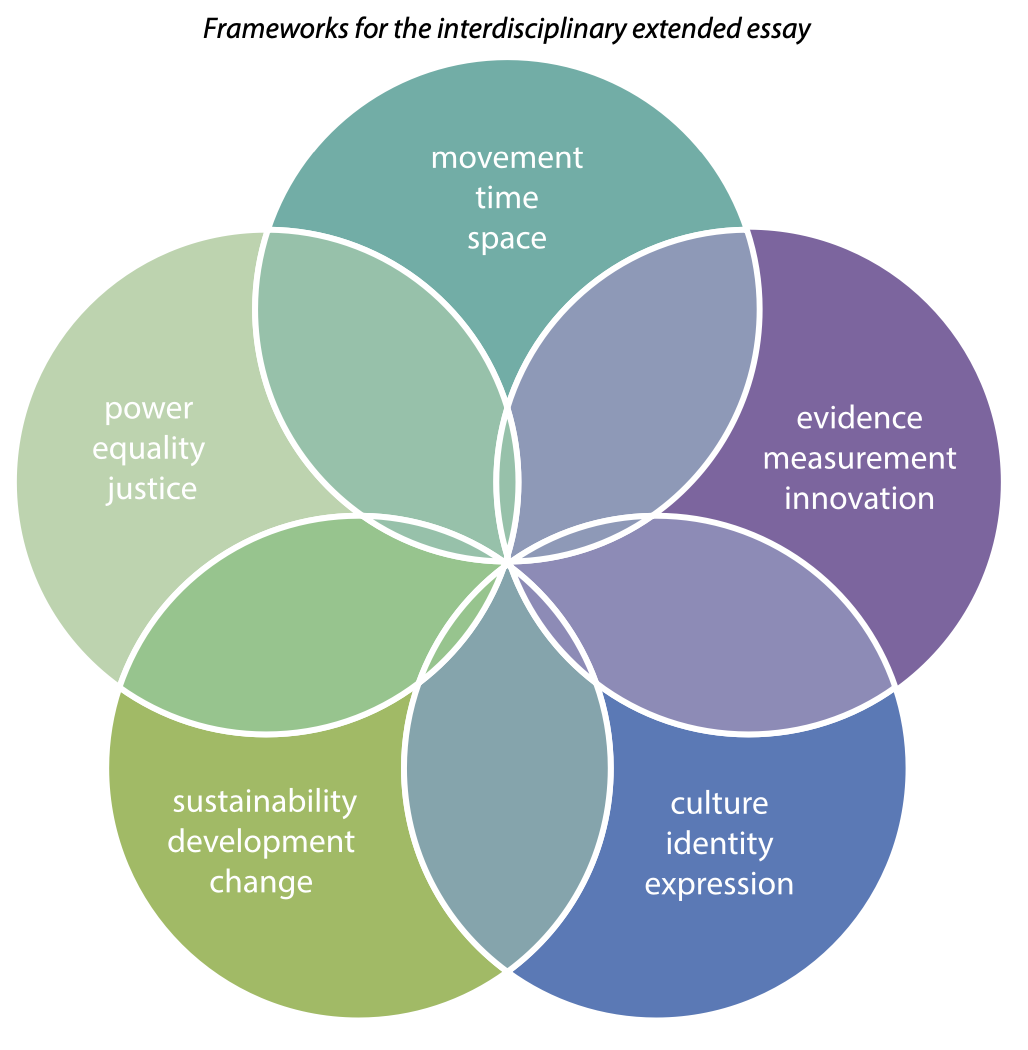 The five frameworks shown above are intended to help you position and shape your ideas for an interdisciplinary extended essay topic. These frameworks enable the inclusion of a broad and diverse range of ideas that may arise from your personal interests. They are designed to help you choose an appropriate context for exploring a topic with an interdisciplinary approach.
The frameworks are depicted as overlapping because, while your topic should broadly fit within one framework, it may also include aspects that relate to another framework or more.
It should be noted that a topic does not need to connect with all the words that describe a framework. For example, in the framework “culture, identity, expression”, the focus might be on “identity” but not “culture” or “expression”.
The same topic could even be placed in an alternative framework, depending on the emphasis of the research question.
While the official registration with the IB of your interdisciplinary extended essay must place it in one of the frameworks, the connection with the framework is not directly assessed. The main purpose of the frameworks is to provide you with initial guidance for the inquiry process, but they will also assist the IB with coordinating the assessment of interdisciplinary essays.
Broad topic areas within the five interdisciplinary frameworks
The number of possible broad topic areas that could kick-start an interdisciplinary extended essay is limited only by your capacity to imagine ideas that you would like to research. Here are some initial suggestions for each of the five frameworks that may help you get started.
Power, equality, justice
Social or political issues—health, education, racism, gender, poverty, fairness, conflict; the body—commodified bodies, violent bodies, bodies as weapons of war.
Culture, identity, expression
Belief systems; politics of identity; political movements; disputed territories; sporting and other competitions; art and science; music; protests; icons; cultural heritage; the body—modifications; literature and science; psycholinguistics; gaming.
Movement, time, space
Migration; refugees; virtual communities; astronomy; travel; urbanism; social media; contested spaces; non-places or non-spaces; conflict; globalization; museums; questions of evolution.
Evidence, measurement, innovation
Art and science; literature and science; cross-scientific inquiry; mathematics in science; gaming; social media.
Sustainability, development, change
Sustainability—environmental, social, economic; development—economic, social; food; health; political issues; poverty.
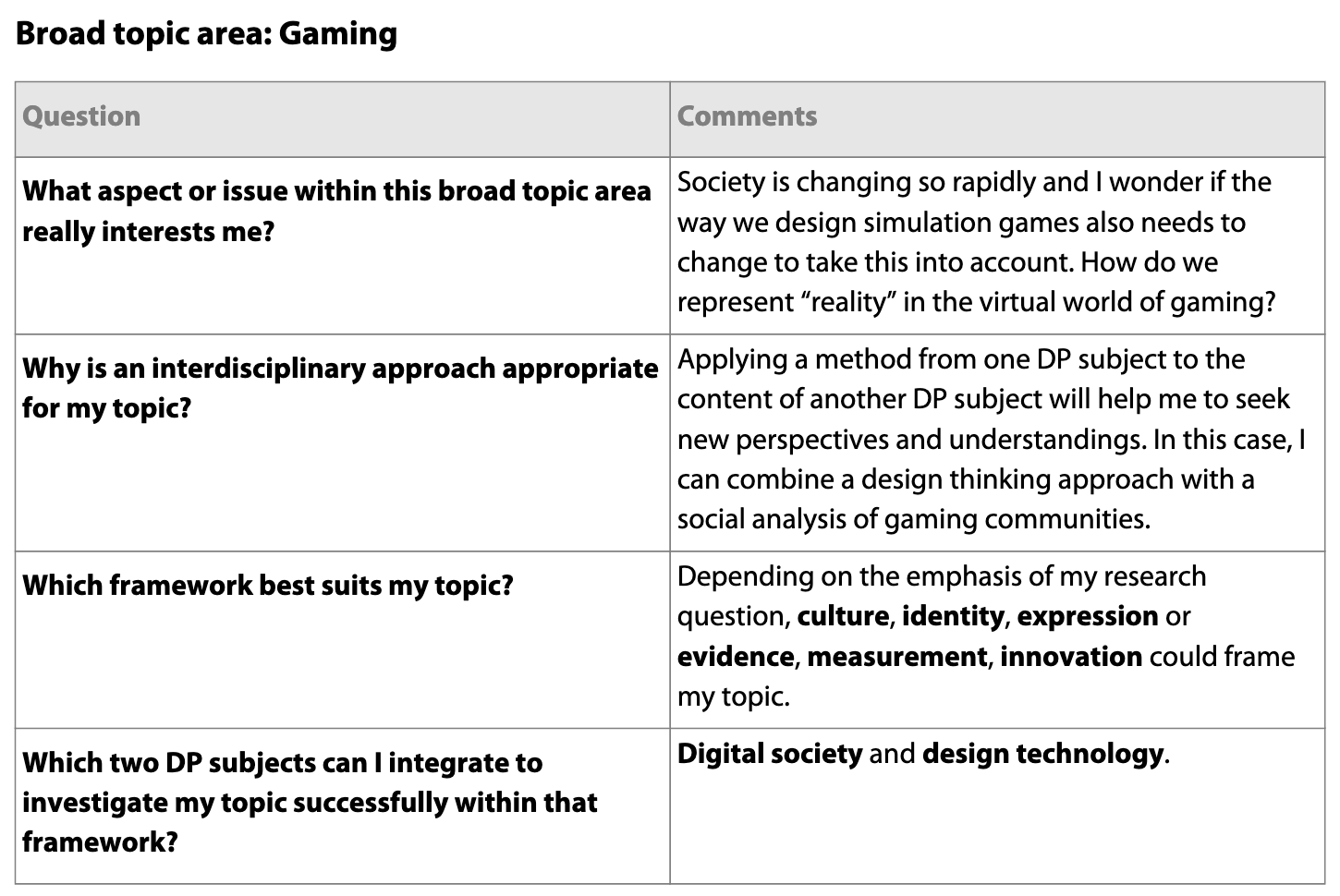
Once you are engaged by an idea, examine your thinking to choose a specific topic. You will probably do some preliminary reading around your topic area to explore what's possible.
Consider:
Finalizing the Topic, Example 1:
Example 2:
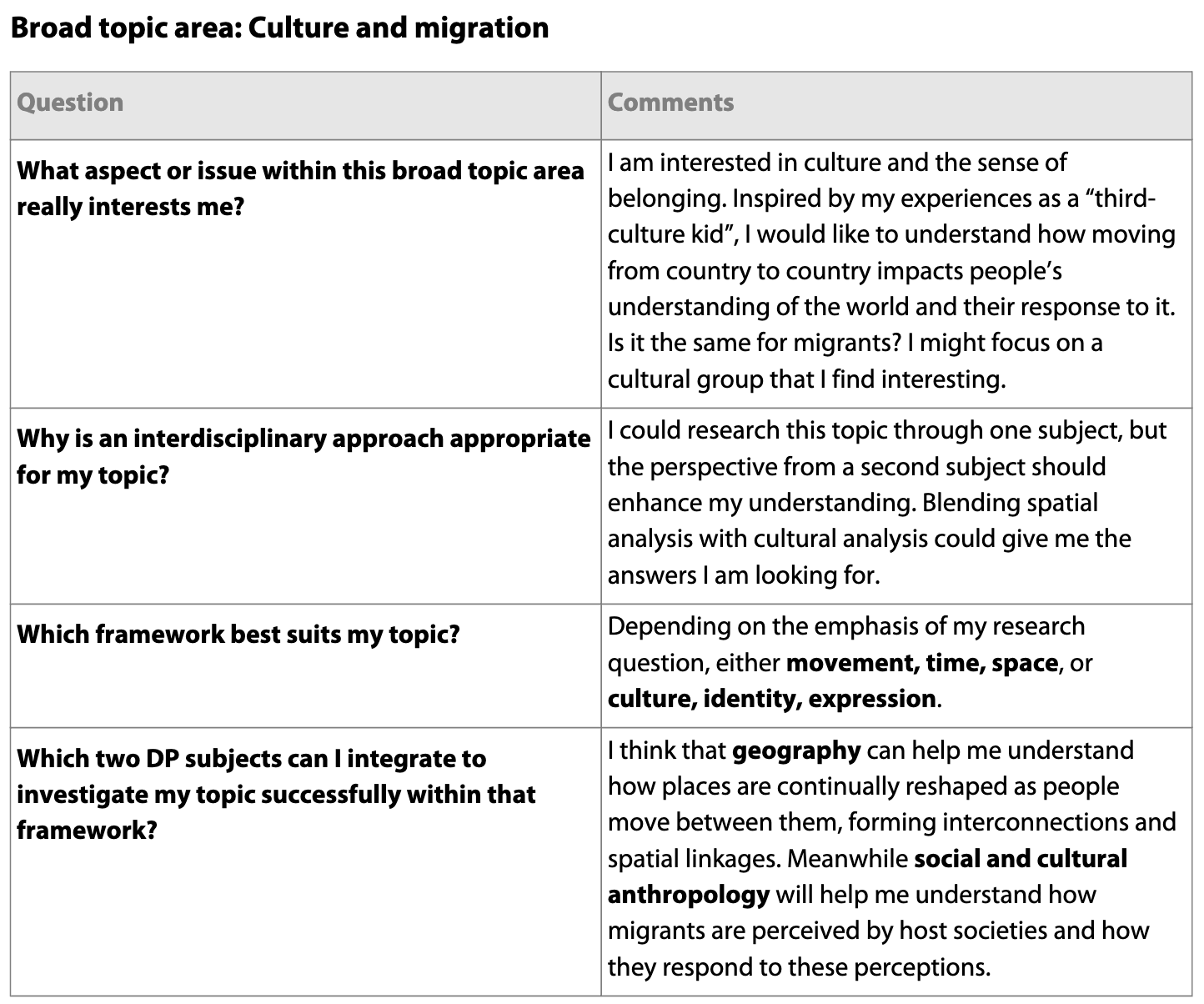
Example 3:
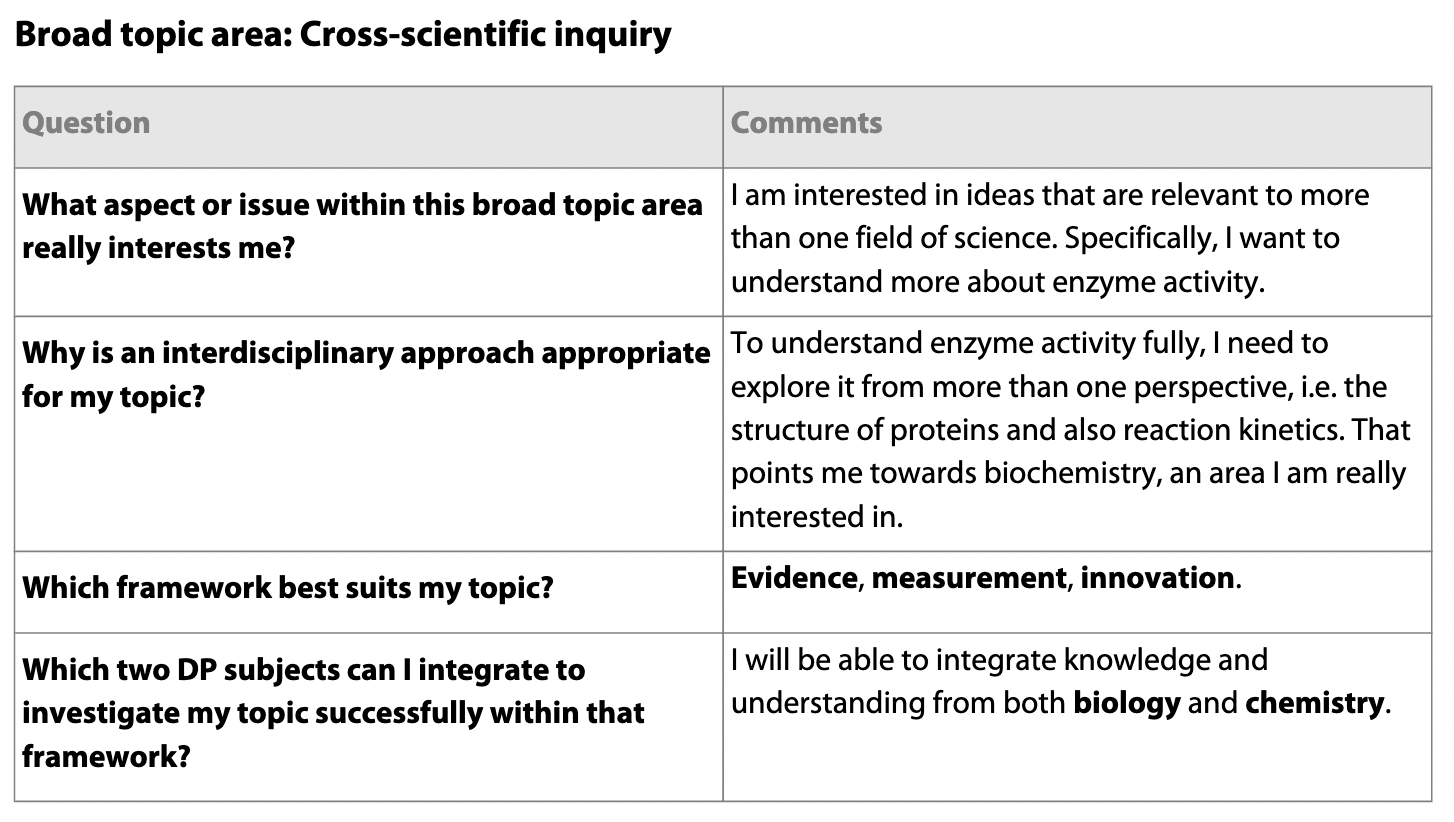 See more examples on page 24 of the EE Guide.
(Written with material from Sarah Ducharme at OIS)
Developing a research question
Once your extended essay topic is ready to take the interdisciplinary pathway—that is, an appropriate framework has been selected, and two DP subjects have been chosen—you then need to develop a research question. Your research question should:
It is also important for you to imagine being able to respond to your research question comfortably within the 4,000-word limit of an extended essay. For more detailed guidance, refer to the “Researching and writing the extended essay” section of this guide.
Topic: The impact of rising economic power on the balance of forces in a particular region
Research question: How has the rise of India as an economic power affected the balance of forces in the region with reference to China and the USA?
Framework: Power, equality, justice
Outline of approach: The research question could be addressed through the following lenses.
Subjects: Integrating two DP subjects: economics and global politics.
Topic: The consequences of gentrification
Research question: In what ways has the gentrification of the historic centre of Lisbon turned the city into a contested space?
Framework: Movement, time, space
Outline of approach: The research question could be addressed through the following lenses.
Subjects: Integrating two DP subjects: geography and economics, or geography and visual arts.
Topic: The relationship between machine learning and political populism
Research question: With reference to the USA, how have the machine learning algorithms of social media impacted the recent growth of political populism and to what effect?
Framework: Evidence, measurement, innovation
Outline of approach: The research question could be addressed through the following lenses.
Subjects: Integrating two DP subjects: mathematics and computer science, or mathematics and global politics.
Topic: Food security and sustainability
Research question: How effective are the measures Singapore has taken since 2018 to ensure food security and sustainability for its people?
Framework: Sustainability, development, change
Outline of approach: The research question could be addressed through the following lenses.
Subjects: Integrating two DP subjects: geography and economics.
Topic: Migrants negotiating their identities
Research question: What are the pressures on migrants obliged to negotiate their identities between their country of origin and their adopted country?
Framework: Culture, identity, expression
Outline of approach: The research question could be addressed through the following lenses.
Subjects: Integrating two DP subjects: social and cultural anthropology and language and literature, or social and cultural anthropology and psychology.
Topic: Representation of Indigenous peoples
Research question: How does Warwick Thornton’s film Samson and Delilah (2009) provoke questions about the Aboriginal voice in Australia?
Framework: Power, equality, justice OR culture, identity, expression, depending on the specific focus of the research.
Outline of approach: The research question could be addressed through the following lenses.
Subjects: Integrating DP subjects: film and psychology, or film and social and cultural anthropology.
Topic: The environmental impact of Bt crops (Bacillus thuringiensis) in developing countries
Research question: What are the negative environmental impacts of Bt crops in developing countries compared with their positive effects?
Framework: Sustainability, development, change
Outline of approach: The research question could be addressed through the following lenses.
Subjects: Integrating two DP subjects: biology and geography, or biology and economics.
Topic: Subversion of the principles of the Irish cultural revival
Research question: How do the characters and the dramatic action in Sean O’Casey’s “Dublin Trilogy”* subvert the principles of the Irish cultural revival (1890–1916)? *The Shadow of a Gunman/Juno and the Paycock/The Plough and the Stars
Framework: Culture, identity, expression
Outline of approach: The research question could be addressed through the following lenses.
Subjects: Integrating two DP subjects: language A and history.
Topic: Disputes over property and land between Israelis and Palestinians
Research question: How do the disputes over property and land in the East Jerusalem area of Sheikh Jarrah reflect the broader conflicts between Israelis and Palestinians on the West Bank of the Jordan River?
Framework: Power, equality, justice
Outline of approach: The research question could be addressed through the following lenses.
Subjects: Integrating two DP subjects: history and global politics.
Topic: The impact of social influencers on marketing
Research question: How has the growing popularity of influencers on Instagram marked an innovative shift in how service industries* market their products? *Examples might be entertainment, fashion, food.
Framework: Evidence, measurement, innovation
Outline of approach: The research question could be addressed through the following lenses.
Subjects: Integrating two DP subjects: digital society and business management.
Topic: The relationship between dance therapy and the cognitive function of dementia patients
Research question: How can dance movement therapy alleviate the symptoms of dementia and improve the cognitive function of dementia patients?
Framework: Evidence, measurement, innovation
Outline of approach: The research question could be addressed through the following lenses.
Subjects: Integrating two DP subjects: dance and psychology.
Topic: The use of space, movement, time and technology in philosophical writing
Research question: How does Robert Pirsig use space, movement, time and technology as structural elements in his book Zen and the Art of Motorcycle Maintenance to explore the purpose of life?
Framework: Movement, time, space
Outline of approach: The research question could be addressed through the following lenses.
Subjects: Integrating two DP subjects: philosophy and design technology.
Regularly refer to the “Assessment of the extended essay” section in this guide as you write your essay—it will be invaluable. Given that your interdisciplinary extended essay brings together the perspectives of two DP subjects, also read the assessment criteria sections of the subject-specific guidance for the two subjects you are using, or the subject group that includes it. You will find this in the “Subject-specific guidance” section of this guide. It is also essential to read the “Generic guidance for the extended essay” section in this guide.
The following table provides some additional guidance about using the assessment criteria that relates specifically to the interdisciplinary approach you have taken.
A: Framework for the Essay (6 pts)
Your research question needs to reflect your interdisciplinary approach. You should explain and justify your use of this approach. The reader should be able to see that you have drawn on the research methods that relate to the two subjects you are integrating. Be aware of any structural conventions that are used in the writing of essays in each of the two subjects you are using, and apply these where relevant.
B: Knowledge & Understanding (6 pts)
You need to show your disciplinary grounding in the two DP subjects that you are combining, through effective use of relevant terminology and concepts. The balance of knowledge and understanding between the two subjects does not necessarily need to be even—this depends on the nature of your research question.
C: Analysis & Line of Argument (6 pts)
The findings that come from your analysis should reflect the combination of the two subject lenses you are using. Your line of argument should give the reader a sense of the development and flow of the integration of the perspectives of the two subjects.
D: Discussion & Evaluation (8 pts)
Discussion is the key tool for integrating the concepts, understandings and, as relevant, theories of the two subjects, in relation to your research question. Evaluation of the effectiveness of your essay can be enhanced by an appraisal of the interdisciplinary approach you have taken.
E: Reflection (4 pts)
See the Reflection tab above for detailed guidance on planning for and writing your reflection. It is worth noting that one of the transferable skills you have learned is applying an interdisciplinary approach to research
There are currently no assessed examples of Interdisciplinary essays. Please look at the assessed examples from the subject-focused pathway EEs. You can also look at World Studies papers from the previous EE Guide last assessment 2026.