
The extended essay presents a unique opportunity for you to investigate a topic of personal interest that is either clearly grounded in one DP subject or is appropriate for an interdisciplinary approach. Your essay should:
An extended essay involves you applying your skills to explore a topic of personal interest in an imaginative, critical, focused way. It is important that you choose a topic that lends itself to critical investigation and analysis, rather than one that steers you towards a descriptive or narrative piece of
writing. A thoughtfully chosen topic that inspires your curiosity and spirit of inquiry paves the way for a strong, interesting essay.
Your topic should provide a context that allows you to design a clear, focused research question. Staying too broad and general almost inevitably leads to descriptive, superficial writing that includes very little critical thinking. In contrast, topics that lead you to develop a refined, achievable research question are likely to encourage the focused application of your skills of discussion, analysis, argument and evaluation.
It is important to be flexible regarding your choice of topic. If your early investigation suggests a shortfall in the availability and suitability of resources needed to support research, be prepared to amend or change your topic.
Your goal is to be analytical, not just descriptive.
A Descriptive Topic is like writing a book report or a Wikipedia summary. It just states the facts.
An Analytical Topic is like a deep-dive podcast or a documentary that asks "Why?" and "How?" It breaks down the facts to build an argument.
Let's see the difference:
❌ Too Descriptive (The "What"):
"The History of the Saturn V Rocket."
Why it's weak: This would lead to you just listing facts: it was built by NASA, it was 363 feet tall, it went to the moon. There's no argument to be made.
✅ Analytical & Focused (The "Why" and "How"):
"To what extent did the political pressures of the Cold War drive the engineering innovations of the Saturn V rocket?"
Why it's strong: This forces you to investigate the relationship between politics and technology. You have to analyze sources, weigh evidence, and build a case about how much one influenced the other.
Starting too broad is the #1 way to get overwhelmed and write a superficial essay. You need to narrow it down into a sharp, manageable Research Question (RQ).
How to Narrow It Down:
Broad Interest: I'm interested in social media and mental health.
Initial Topic: The impact of Instagram on teenagers. (Still too broad! What kind of impact? On which teenagers?)
Focused Research Question: *"To what extent does exposure to 'fitspiration' content on Instagram correlate with body image dissatisfaction among 16-18 year-old girls in the United States?"*
Why this RQ works:
Focused: It's not about all social media or all teenagers. It's about a specific type of content on a specific platform for a specific group.
Researchable: You can find studies on fitspiration, body image, and social media.
Analytical: It asks "To what extent?" requiring you to evaluate the strength of the correlation, not just say it exists.
Another Example:
Broad Interest: I love the novel To Kill a Mockingbird.
Initial Topic: Racism in To Kill a Mockingbird. (Too broad and descriptive.)
Focused Research Question: "How does Harper Lee use the symbolism of the mockingbird to critique the failure of the justice system in the American South?"
Why this RQ works:
Focused: It zooms in on one literary symbol (the mockingbird) and connects it to a specific theme (the justice system).
Analytical: It requires you to analyze the text, explain the symbol's meaning, and build an argument about Lee's critique.
Stay flexible. Your first idea might not be the winner, and that's totally normal. It's a sign of a good researcher to change course when you hit a dead end.
The Problem: You want to investigate "The influence of K-pop on global fashion trends," but you quickly find there are very few academic articles or books on this specific topic.
The Smart Pivot: Don't give up on your interest! Adjust your question to something more researchable. For example: "How has BTS's collaboration with luxury fashion house Dior served as a case study for the 'Korean Wave's' entry into Western high fashion?"
This new question is more focused on a specific event (the collaboration) and might have more available sources like news articles, interviews, and marketing analyses.
The Bottom Line:
Choose a topic that makes you say, "Wait, I actually want to know the answer to that!" A question that sparks your own curiosity will lead to an essay that is not only strong but also much more enjoyable to write.
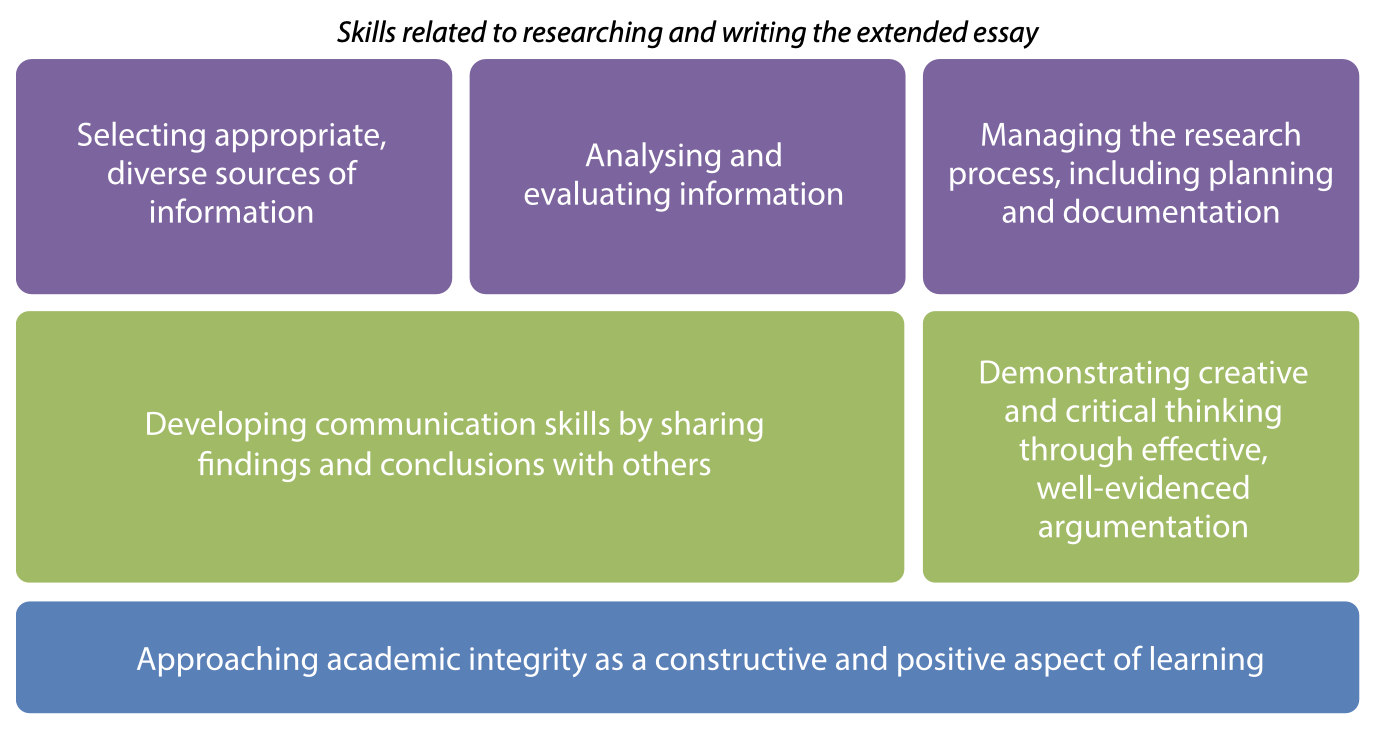
Once you are happy with your choice of topic, it can be refined, narrowed and used to generate a workable, focused research question that will drive your research and writing and lead to the enhancement of the research and related skills shown below:
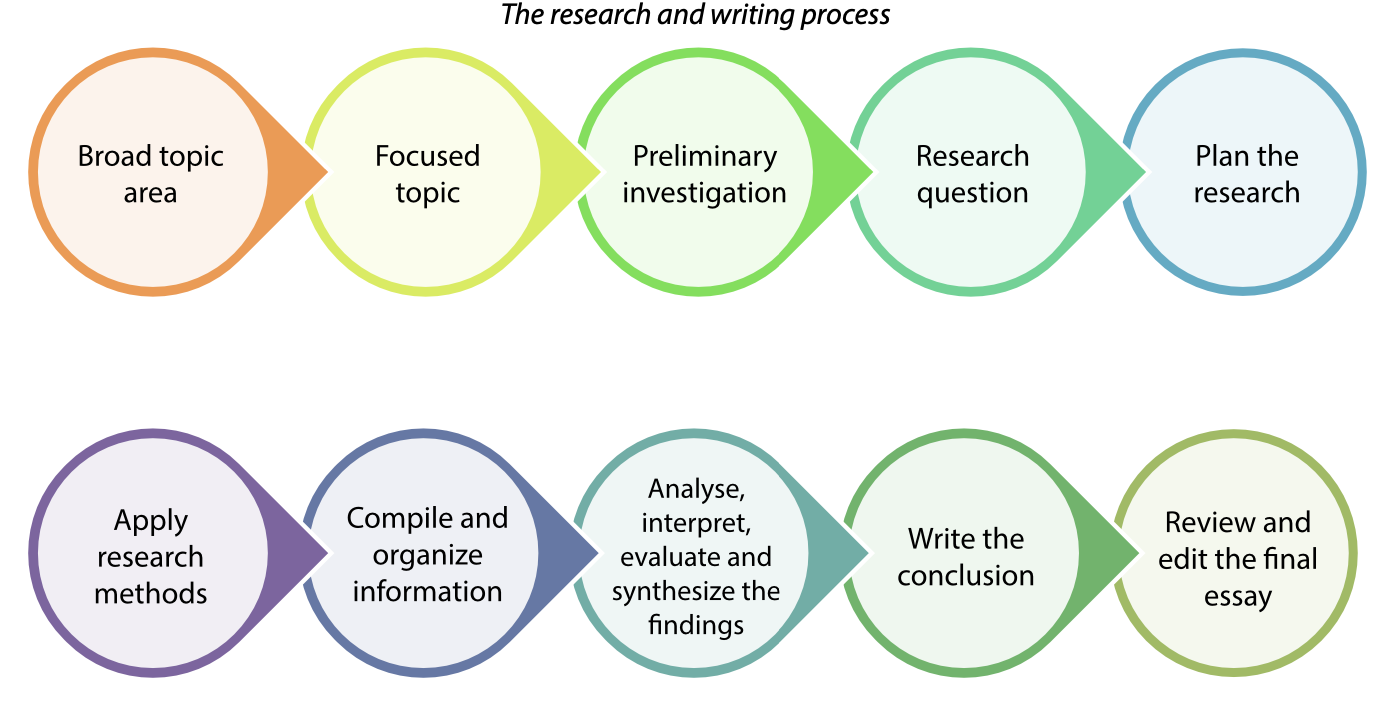
The research and writing process
The figure below outlines the research and writing process that underpins your extended essay. However, this process may unfold in slightly different ways or with a different order of events.
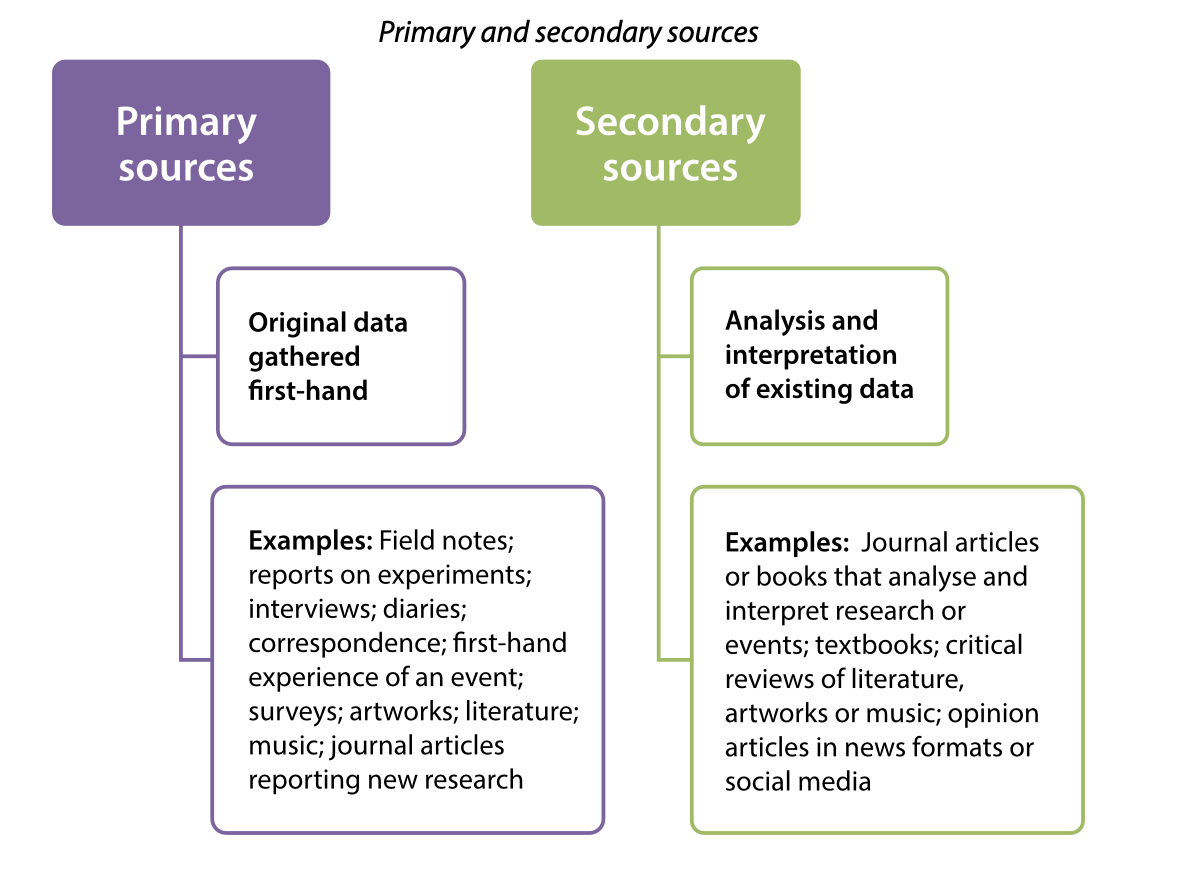
In terms of gathering data, primary research sources are original data that has been gathered through research that is undertaken first-hand, through methods such as interviews, surveys, focus groups, experimentation, observation or participant observation. Secondary research is carried out by analysing or interpreting existing data that has been collected by others (see figure 9).
Secondary research—a review of the literature available on your chosen topic—is a requirement for each extended essay, regardless of pathway and subject(s) selected. In general, most DP extended essay subjects require the use of both primary and secondary research sources. However, this is not always the case, and you should check the subject-specific guidance to find out the rules on collecting primary research in certain subjects.
If you have gathered primary data for a different original purpose than for your extended essay, it may be used to support your extended essay research, provided that the discrete approach for your topic is clearly explained.
Remember that examiners are referring to the extended essay assessment criteria as they read your work and ultimately use these to inform their decision about what grade you receive (see the “Assessment of the extended essay” section in this guide). Therefore, you too will want to refer closely to the criteria as you write your essay.
The following guidance about using the assessment criteria to inform the writing of your essay is complemented by further advice in the “Subject-specific guidance” section of this guide.
Research question
Make sure the research question arises from the context of a specific topic that is related to your chosen DP subject(s) and that it really is a question. The question should be specific and focused. Make clear to the reader the significance and purpose of the research question and ensure that it connects with the knowledge and understanding evident in your essay.
The research question should:
Research methods
Explain the suitability of the research methods you have chosen to conduct your research and understand how these connect with the methodology of the subject(s) used. Remember that “methodology” is the overall research strategy and rationale, the lens through which the analysis occurs. Meanwhile, “research methods” are the specific tools and procedures used to collect and analyse data.
If the approach to the essay involves experimentation or fieldwork, provide a description of the methods used that would allow the work to be repeated.
Make sure the reader can see evidence of how you have applied your chosen research methods.
Ensure that there are sufficient sources of suitable quality to allow effective research using your chosen methods. If there are not enough, you may need to amend or change your research question or even reconsider your topic.
Structure
A successful academic essay generally follows the basic structure seen below:
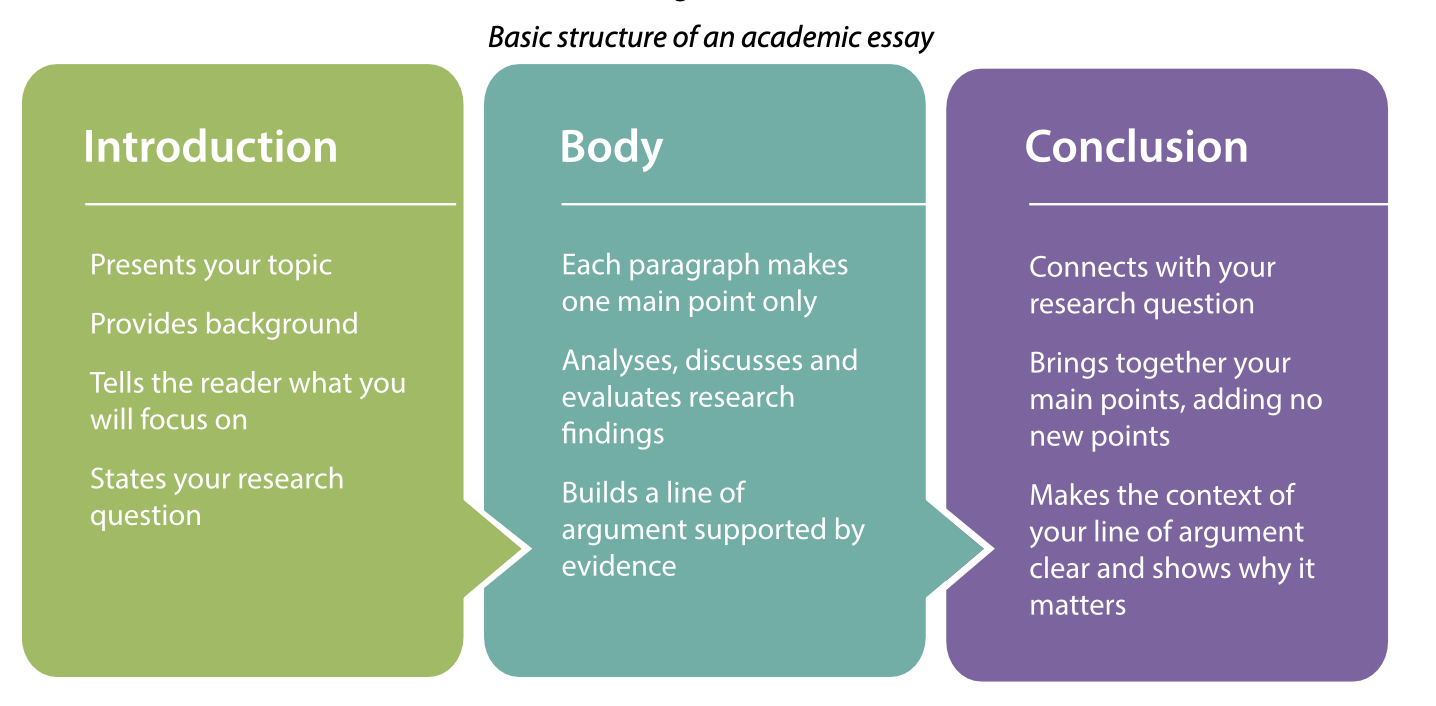
More specifically, as you write your extended essay you will need to be aware of any structural conventions that relate to academic writing in your chosen subject(s), for example, biology, geography, literature. Structural conventions are rules that should be followed. For instance, in geography and science essays, figures and tables are often used (though they are only included if they help to illustrate a point you are making). Figures and tables should always be clearly labelled and referred to in your essay text, for example, “the population has grown considerably over the last two decades (see figure 1)”.
For specific advice on any structural conventions that relate to your extended essay subject(s), refer to the “Subject-specific guidance” section in this guide.
Knowledge
The reader should be able to see that you have thoughtfully applied the research findings to explore the topic systematically and build your knowledge of its subject matter. Research findings can include information from reviewing the literature, secondary sources, and data collected and processed. It should be relevant to the research question and support the development of arguments.
Avoid over-extensive quoting from your sources; your knowledge needs to be evident in your own writing. Remember, knowledge is important; it underpins the analysis, discussion and evaluation that demonstrates your critical thinking.
Understanding—Terminology
Subjects are to some extent identified by the specific terminology or “jargon” that academics use when writing or talking about them. If you incorporate subject-related terminology accurately and consistently in the writing of your extended essay, it helps to show that you understand the topic and the subject(s) it relates to. For example, incorporating the terminology “cells”, “cytoplasm” and “lipid” in a biology extended essay: “Typical cells have DNA as genetic material and a cytoplasm composed mainly of water, which is enclosed by a plasma membrane composed of lipid”.
Understanding—Concepts
In terms of the subjects that you study in the DP, concepts are the key ideas around which knowledge is developed. Correctly using concept words or phrases in your writing shows your understanding of the context of the research and supports well-founded analysis. For example, using the concept “marginalization” in a social and cultural anthropology extended essay: “Decades of marginalization has relegated this community to the edge of society, economically, politically, culturally and socially, limiting their access to productive resources and avenues for the realization of their productive human potential.”
Analysis
Analysis means breaking down your topic to bring out its essential elements or structure; you can use your research question as a prompt. The aim is to understand the topic better and to demonstrate this in your writing by establishing relevant findings derived from your research. When you make a particular point of analysis, be sure to support it with relevant evidence from your research.
If your essay is largely descriptive or narrative, it is unlikely to provide sufficient evidence of your skills of analysis.
Line of argument
A line of argument is a reasoned thread that runs through your essay, linking its various elements, bringing overall coherence and supporting the position you are taking. In other words, it is a set of logical connections with signposts that help the reader to see where your argument has come from and where it leads. A clear line of argument will complement your analysis and contribute to a convincing and effective piece of writing.
Why is this necessary? It helps the reader follow the logic of your argument, so they can see a clear pathway through the details of data, quotations and information that you present to support your position. Just as importantly, it also helps you, the author, to navigate your way clearly as you work through the subsections of the essay. A solid line of argument:
Ideally, you want the reader to be able to agree with your conclusions. For this to happen, they will need to be able to see how you have linked together the various parts of the essay in a logical and effective way.
You do not want the reader to be asking, “This is interesting but how do the different parts fit together?”. The “fitting together” is your job as the author, not the job of the reader. The way the elements of the essay fit together should be obvious and explicit. There should be:
What are the key elements of a “line of argument”? An extended essay typically has certain subsections that may be signposted by chapter headings or may emerge organically from the way the essay is written, as follows.
These sections are the key elements of the line of argument. Their beginnings and ends need to be signposted so the reader knows where they start and finish. To create an effective line of argument, you do not need to add an “extra layer”, or an extra paragraph, to the essay. Instead, you connect the parts that you would typically use, in an effective and explicit way.
For further advice on how to start, build and sustain your line of argument, refer to the appropriate section of the Extended essay support material.
Discussion
To demonstrate your discussion skills, you need to offer a considered and balanced review of the significance of your research findings that includes a range of factors or perspectives. Opinions or conclusions should be presented clearly and supported by appropriate evidence. Compelling arguments are developed through thoughtful analysis of the evidence obtained from research.
Evaluation
As a discerning author of an extended essay, it is important to evaluate the effectiveness of your essay by appraising your research materials, weighing up their strengths and limitations. This includes being aware of the stated or implied positions and views of the writers. Evaluation goes hand in hand with discussion and feeds into your line of argument as you work your way towards showing the reader that you have reached a well-founded conclusion.
Evaluative
As you reflect on your extended essay experience, to be evaluative you need to consider the value of its impact on you as a learner. Give explicit examples of how you have transferred the skills you have learned to apply them in other contexts.
To reflect on your growth as a consequence of doing the extended essay, consider these questions: How did changes in perspective impact your decision-making? How might your experiences and insights shape your future thinking, including how you envisage transferring the skills and lessons you have learned to other circumstances, such as future studies, career or life in general?